Tel : 01273 936055
Is Stone Floor Restoration Worth the Money
Is Stone floor restoration worth the money? As a professional service with a professional price tag, before you commit, you want to know that you're going to see get value for your money
4/1/20265 min read
Is Stone Floor Restoration Worth the Money?
It's a fair question. Stone floor restoration is a professional service with a professional price tag, and before you commit, you want to know that you're going to see genuine value for your money. The honest answer — for the vast majority of Sussex homeowners — is yes, comfortably so. But rather than just saying that, let us show you why.
In this article we'll look at the financial case, the lifestyle benefits, the impact on your property, and the specific circumstances where restoration offers the best return. By the end you'll have a clear, balanced picture to make your own decision with confidence.
The financial case: restoration vs the alternatives
The most straightforward way to assess whether restoration is worth it is to compare it to the alternatives — and the numbers are quite striking.
When you lay those options side by side, professional restoration occupies a very sensible middle ground. It costs a fraction of replacement, delivers results that DIY simply cannot match, and — critically — it stops the gradual deterioration that, left unchecked, can eventually make full replacement unavoidable.
Restoration typically costs 50–75% less than full floor replacement. For a typical Sussex hallway, kitchen or living room, that difference can run to several thousand pounds.
Five reasons restoration is worth it
1. It protects an asset that's already paid for
When your stone floor was first laid, someone paid a significant amount for it — the stone itself, the specialist installation, the sealing. That investment is sitting under your feet right now. Restoration is the most cost-effective way to protect and extend the life of that asset. Leaving it to deteriorate further doesn't save money; it accelerates the point at which you have no option but to replace it entirely.
2. The results genuinely transform the space
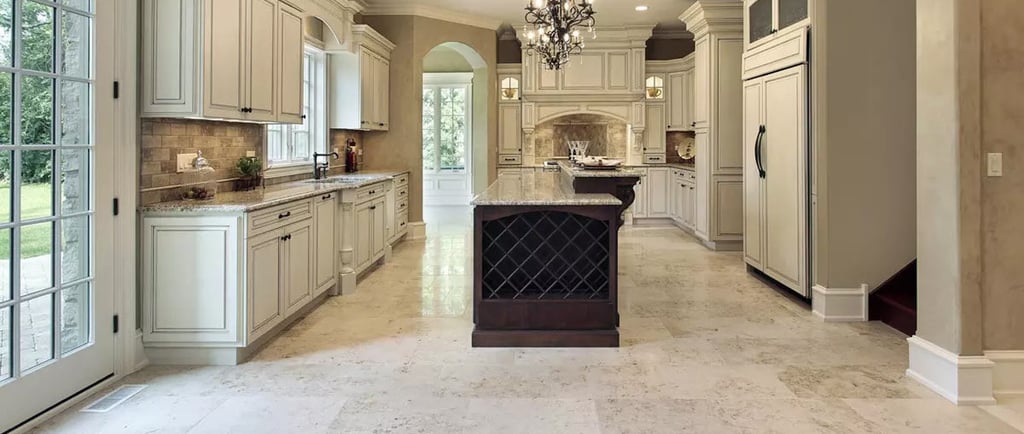
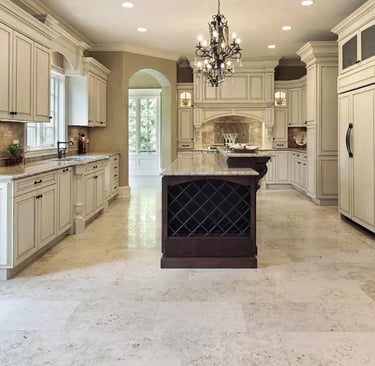
This is something that's hard to fully convey in words, but easy to appreciate the moment it happens. A properly restored stone floor — whether it's marble in a hallway, limestone in a kitchen, travertine in a bathroom or slate in a period property — can look as good as the day it was first laid. Often better. The depth of colour, the reflective quality, the clean grout lines: it changes the feel of a room in a way that's immediately noticeable to everyone who walks into it.
3. It adds appeal when selling
Natural stone floors are a genuine selling point in the Sussex property market — particularly in period homes across Brighton & Hove, Lewes, Eastbourne, Chichester and the wider county. Estate agents consistently report that well-maintained original stone floors create strong first impressions and can make a meaningful difference when buyers are comparing similar properties. A professionally restored floor before going to market is one of the highest-return home improvements you can make — the cost is modest relative to the potential uplift in sale price or speed of sale.
4. Natural stone lasts for generations
Unlike carpet (which needs replacing every 8–12 years), laminate (typically 15–25 years) or even engineered wood, properly maintained natural stone can last for centuries. Historic Sussex properties contain original stone floors that are hundreds of years old and still beautiful. Restoration works with this extraordinary longevity — every time you restore rather than replace, you're extending the life of a material that was already designed to outlast you. Spread the cost of restoration over the expected lifespan of the floor, and the value becomes even clearer.
5. It prevents problems from escalating
Stone floors that are left unsealed or neglected become progressively harder and more expensive to restore. Stains that are dealt with early come out cleanly; stains left for years penetrate deeply and may be impossible to fully remove. Scratches that are addressed before they go too deep are straightforward to grind out; deep gouges require more aggressive treatment. Regular professional restoration — every five to ten years for most residential floors — keeps costs manageable and results consistently excellent.
What does good value restoration actually look like?
Worth is only meaningful if the work is done properly. Here's what separates a restoration that genuinely delivers value from one that doesn't:
What good value looks like
A reputable contractor will start with a free site survey, give you a written quote that clearly sets out what's included, use professional diamond grinding and polishing equipment (not off-the-shelf products), apply a quality impregnating sealer as standard, and offer a workmanship guarantee. If a quote arrives without a site visit or is significantly lower than others you've received, approach it with caution.
The restoration market, like any specialist trade, has a wide range of quality. A poor job — using the wrong methods for your stone type, over-grinding a thin slab, or applying an inferior sealer — can cause lasting damage and leave you worse off than before. The value comes from getting it done right, by someone with the right experience and equipment.
When is restoration worth it most?
Restoration offers the best return in these situations:
Period properties in Sussex — original stone is often irreplaceable, and restoration preserves both character and value
Floors that have been neglected but are structurally intact — the bigger the visible improvement, the more dramatic the return
Before selling — a restored floor can make a strong impression on buyers at relatively low cost
Marble, limestone and travertine floors — these respond especially well to professional restoration and can reach a very high standard
Large floor areas — the per-square-metre cost falls as the area increases, improving the value further
Homes where the stone floor is a focal feature — hallways, open-plan kitchens, entrance areas where the floor is immediately visible
And when might it be less straightforward?
Being honest is important here. Restoration is not always the right answer for every floor, and it's worth knowing the exceptions:
If the stone is structurally damaged — cracked through its full depth, lifting from the subfloor, or suffering from damp beneath — surface restoration alone won't resolve the underlying problem
If the stone is very thin (under 20mm) — grinding may not be possible, which limits how much surface damage can be corrected
If you actively want a different look — restoration returns your floor to its best version of itself, not a different stone entirely
In these cases, a good contractor will tell you clearly before taking your money. If you're not sure which category your floor falls into, a free site survey is the best starting point.
A straightforward verdict
Our honest answer
For the vast majority of Sussex homeowners with structurally sound stone floors, professional restoration is absolutely worth the money. It costs a fraction of replacement, delivers a transformation that's immediately noticeable, protects an existing investment, and adds genuine appeal to your property. The key is choosing a contractor who does the job properly — and that starts with getting a free, no-obligation survey before committing to anything.
Find out exactly what your floor needs — and what it will cost.
We offer free, no-obligation surveys and written quotes across East and West Sussex — including Brighton & Hove, Lewes, Eastbourne, Chichester, Worthing, Horsham and surrounding areas. Come and see for yourself what your stone floor could look like.
Visit: sssr.co.uk/contact
Contact us
SSSR
4 The Twitten
Albourne
BN69DF
info@sssr.co.uk
01273 936055
SSSR© 2026. All rights reserved.
Stone Floor Restore Limited : Trading as SSSR
Company Number : 17402188