Tel : 01273 936055
Can Professional Restoration Fix Scratched Stone Floors?
A simple guide explaining what to expect when restoring a damaged stone floor.
Jon Hillier
5/12/20264 min read
Can Professional Restoration Fix Scratched Stone Floors?
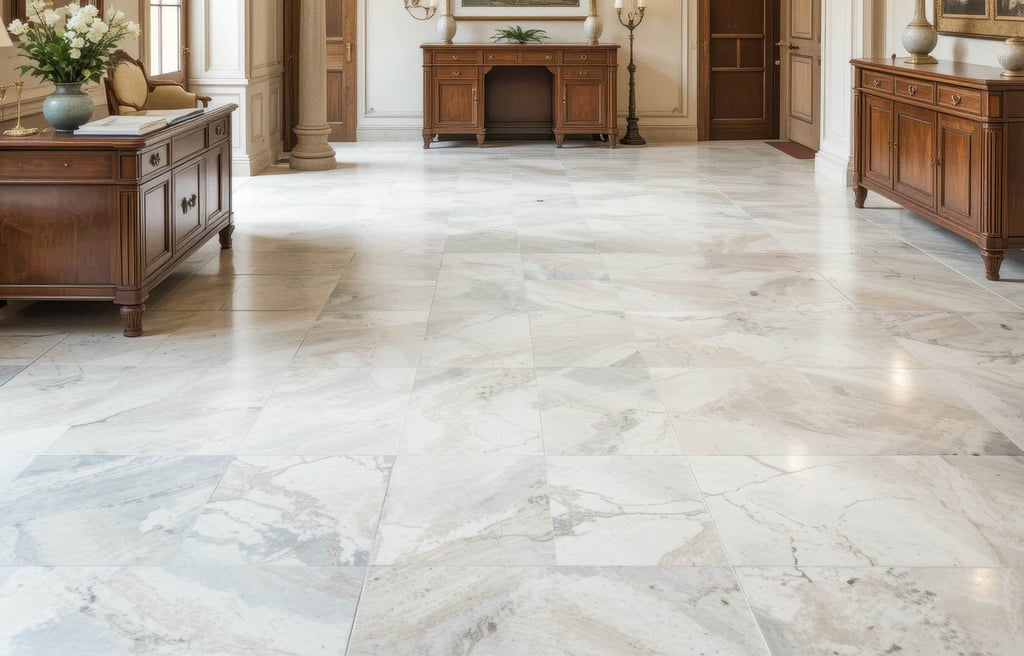
This is one of the most common questions we get from Sussex homeowners, and the short answer is yes, in almost every case. Scratched stone floors can be restored to a smooth, consistent finish that often looks better than it did on the day the floor was first laid. But the process depends on the type of scratches you have, how deep they go, and what type of stone the floor is made of.
This guide explains what professional scratch removal entails, which scratches can be completely eliminated and which can only be reduced, and what you can realistically expect from a restoration of a scratched floor.
Why do stone floors get scratched
Even the hardest natural stones develop scratches over time. The most common causes are surprisingly simple:
Grit and fine particles tracked in on shoes, these act like sandpaper underfoot and cause the gradual, all-over scratching that dulls a floor
Furniture moved without lifting chair legs, table feet, and heavy items dragged across the floor leave linear scratches that can be deep
Dropped objects, particularly heavy or sharp items, hitting the floor can leave chips and gouges
Pet claws, most common on softer stones like limestone and travertine, are less of an issue on granite
Abrasive cleaning products or pads used incorrectly leave a surprisingly common cause of swirl-pattern scratching
Some scratches are obvious individual marks. Others, particularly the cumulative scratching from grit, are subtle but show up as overall dullness rather than visible lines. Both types respond to professional restoration.
How professional scratch removal works
Professional stone scratch removal isn't a coating, a polish or a chemical treatment. It's a mechanical process that physically removes a very thin layer of the stone itself, taking the scratches with it. The technique used depends on the depth of the scratching:
Light scratching — diamond honing
For surface-level scratches and the general dullness caused by foot traffic, diamond honing is usually sufficient. Progressively finer diamond abrasive pads work across the floor, refining the surface and eliminating scratches as they go. The stone is left smooth, consistent and free of visible scratching. This is the most common treatment for residential floors in Sussex and produces excellent results with a relatively quick turnaround.
Deeper scratches — diamond grinding followed by honing
Where scratches are deeper, typically from furniture being dragged or significant wear in high-traffic paths, a more intensive process is needed. Diamond grinding using coarser abrasives removes a slightly thicker layer of the stone, eliminating the deeper scratches in the process. This is followed by progressively finer honing to refine the surface back to a smooth, consistent finish. Up to around 5mm of the surface can be removed where necessary to correct severe damage, though for most floors only a fraction of that is needed.
Gouges and individual deep marks — resin repair before honing
Where a gouge is too deep to grind out without removing an unreasonable amount of stone, a different approach is used. Colour-matched epoxy resin is applied to fill the damaged area, then ground flush with the surrounding stone surface. Once cured, the repair is invisible from normal viewing distance, and the floor is then honed and polished as a whole to integrate the repair seamlessly.
Stone hardness matters
Harder stones like granite take longer to grind and hone than softer stones like limestone because diamond abrasives have to work harder to cut through the surface. This affects both the time the job takes and the overall cost; granite restoration typically sits at the higher end of the pricing range for this reason. But the process and the result are essentially the same: scratched stone returned to a smooth, consistent finish.
What about etching, dullness and other surface damage?
Scratches are rarely the only issue on a worn stone floor. Most of the time, scratches show up alongside related problems that all need addressing as part of the same restoration:
Etching from acidic spills, particularly on marble, limestone and travertine. Removed by the same honing process that addresses scratches
Surface dullness from cumulative wear is eliminated when the surface is refreshed by honing or polishing
Lippage from uneven tiles is corrected during the grinding stage of a full restoration
Failed sealer, addressed by the resealing stage at the end of the process
Discoloured grout can be cleaned or replaced separately as part of the overall job
The good news is that professional restoration addresses all of these issues in a single coordinated process. You don't need separate treatments for scratches, dullness and etching; they're all resolved together.
What you can realistically expect from the result
For the vast majority of scratched stone floors in Sussex, professional restoration produces a result that looks at least as good as the floor did when it was first laid — and often noticeably better, because the modern abrasives and sealers we use today are more advanced than what was originally available.
There are limits, though. Very deep gouges that penetrate more than half the thickness of a thin tile may require the tile to be replaced rather than restored. Cracks that have caused structural movement in the floor can be repaired cosmetically, but the repairs may not be entirely invisible. A stone that has been damaged by inappropriate cleaning products over many years may show subtle differences in colour even after restoration. A reputable contractor will be honest with you about these limits at the survey stage.
How long does scratch repair restoration take?
For a typical residential Sussex floor, let’s say a 20m² kitchen or hallway with general scratching and dullness, the restoration is usually completed in a single day, sometimes spilling into a second day for sealing. Larger floors, floors with extensive deep scratching, or floors requiring multiple gouge repairs may take two to three days. We'll always give you a realistic timeline at the survey stage before any work begins.
The floor needs to dry fully before sealing, typically 24 hours, and then a further 24 to 48 hours for the sealer to cure before normal use. So while the active work is usually quick, the room is effectively out of use for two to three days from start to finish.
Got a scratched stone floor in Sussex? Let us take a look.
We offer free, no-obligation surveys for scratched and damaged stone floors across East and West Sussex — including Brighton & Hove, Lewes, Eastbourne, Chichester, Worthing, Horsham, Haywards Heath and all surrounding areas. We'll assess what's possible, explain the options honestly, and give you a written quote with no pressure.
Visit: sssr.co.uk/contact | Call: 01273 936055
Contact us
SSSR
4 The Twitten
Albourne
BN69DF
info@sssr.co.uk
01273 936055
SSSR© 2026. All rights reserved.
Stone Floor Restore Limited : Trading as SSSR
Company Number : 17402188