Tel : 01273 936055
Limestone Floor Restoration in Sussex
Professional Care Guide
Jon Hillier
4/17/20264 min read
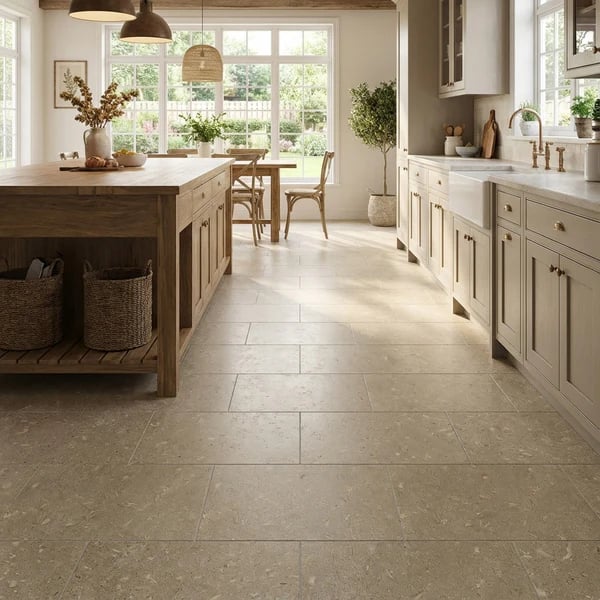
Limestone Floor Restoration in Sussex — Professional Care Guide
Limestone is one of the most popular natural stone choices for Sussex homes. Its warm, earthy tones, quiet texture and timeless character work beautifully across a huge range of property types — from flint cottages in the Weald and Georgian townhouses in Lewes, to contemporary open-plan kitchens in Worthing and Chichester. But limestone is also one of the most demanding stones to care for correctly, and one where the wrong approach — whether that's the wrong cleaning product or the wrong restoration technique — can cause real and lasting damage.
This guide explains what makes limestone behave differently to other stones, what professional restoration involves, what finish to expect, and what it typically costs across East and West Sussex.
What makes limestone different — and more vulnerable
Limestone is a sedimentary rock, formed over millions of years from the compressed remains of marine organisms. Its structure is calcium carbonate — the same mineral that makes up chalk and marble — and that chemistry is what defines both its beauty and its vulnerabilities.
Limestone reacts to acids
This is the single most important thing to understand about limestone. Calcium carbonate dissolves when it comes into contact with acids — and many everyday household substances are acidic: white wine, fruit juice, coffee, vinegar, many bathroom cleaners, and even some supposedly 'natural' cleaning products. When these contact an unsealed or under-sealed limestone floor, they chemically etch the surface, leaving dull white or chalky marks that cannot be cleaned away. They are physical damage to the stone itself, and the only remedy is professional honing to remove the affected surface layer.
Limestone is porous and stains readily
Even well-sealed limestone will absorb liquids if spills are left for any length of time. Unsealed limestone can stain almost immediately from oils, wine, coffee and coloured liquids. This porosity is why professional-grade sealing after restoration is not optional — it is the essential final step that protects everything achieved during the restoration process.
Limestone is softer than most other stone floors
On the Mohs hardness scale, most limestones sit between 3 and 4 — significantly softer than marble (around 5), granite (6–7) or slate (5–6). This softness means limestone scratches more easily from grit and foot traffic, and it also means the achievable polish is more limited. While marble can be brought to a high-gloss mirror finish, most limestone reaches what professionals call a 'honed' or 'high hone' a smooth, consistent satin sheen rather than a true polish. For some varieties the finish is naturally matte, and attempting to force a high gloss can leave the stone looking milky or uneven.
An important note on finish
Not all limestone can achieve the same level of shine. Before agreeing a restoration, a reputable contractor will assess your specific stone and tell you honestly what finish is achievable. If someone promises a high-gloss polish on a stone that naturally won't support one, that's a warning sign — the result will be disappointing and may damage the floor.
Common limestone floor problems in Sussex homes
The issues we most commonly see on limestone floors across East and West Sussex include:
Acid etching — dull, whitish patches caused by contact with acidic cleaning products, wine, juice or coffee. Very common and frequently mistaken for staining by homeowners
General dullness — gradual loss of the honed finish through foot traffic and grit, often so slow the homeowner barely notices until they see an old photo
Deep scratching — visible scratches from grit, furniture or heavy footfall, particularly in hallways and kitchens
Staining — absorbed liquid stains, particularly in kitchens around food preparation areas and near doorways
Discoloured or deteriorating grout — often the most visually obvious issue, making the whole floor look neglected
Failed sealer — water no longer beading on the surface, meaning the stone is unprotected and vulnerable to staining
Chips and cracks — particularly in higher-traffic areas or where heavy objects have been dropped
Professional limestone restoration is a carefully staged process. Each stage matters, and skipping or rushing any of them compromises the final result.
As a practical guide, a limestone kitchen floor of around 20m² in standard condition — dull, some etching, sealer starting to fail — would typically cost in the region of £900–£1,300 for a full professional restoration including sealing.
Limestone floors in Sussex period properties
Limestone is particularly common in Sussex's wealth of period and listed properties. It was widely used in Georgian and Victorian homes throughout Brighton & Hove, Lewes and Chichester, and continues to be specified in high-quality new builds and renovations across the county. In older properties especially, original limestone floors carry real character and heritage value that replacement simply cannot replicate.
Period limestone floors sometimes present additional considerations — thinner tiles from decades of use, original lime mortar that behaves differently from modern adhesives, or unusual stone varieties that require specific assessment. A contractor with experience working on period Sussex properties will understand these nuances from the outset.
Maintaining your limestone floor after restoration
The care you give a limestone floor after professional restoration makes a significant difference to how long the finish lasts.
Clean only with a pH-neutral stone-safe cleaning product — never bleach, vinegar, lemon-based products, bathroom sprays or standard multi-surface cleaners
Wipe up spills immediately — especially anything acidic. Coffee, wine, fruit juice and fizzy drinks will etch unsealed or under-sealed limestone very quickly
Use good entrance matting to stop grit being carried onto the floor — grit is the primary cause of gradual scratching that dulls limestone over time
Place felt pads under all furniture legs, and lift rather than drag furniture when moving it
Have the floor resealed every two to three years — or sooner if the water bead test shows the sealer is no longer performing
Consider an annual professional maintenance clean to keep grout lines fresh and the surface in good condition between full restorations
How long will the finish last?
A professionally restored limestone floor in a Sussex home, well maintained and resealed regularly, can hold its finish for five to eight years before needing significant restoration work again. The biggest factors are foot traffic, whether the right cleaning products are used consistently, and how promptly spills are dealt with. Limestone in a busy kitchen will need more frequent attention than limestone in a quieter reception hallway.
Have a limestone floor in Sussex that needs professional care?
We specialise in limestone floor restoration across East and West Sussex — including Brighton & Hove, Lewes, Eastbourne, Chichester, Worthing, Horsham, Haywards Heath and all surrounding areas. We offer a free, no-obligation survey and written quote, and every job includes a professional impregnating sealer as standard.
Visit: sssr.co.uk/contact
Contact us
SSSR
4 The Twitten
Albourne
BN69DF
info@sssr.co.uk
01273 936055
SSSR© 2026. All rights reserved.
Stone Floor Restore Limited : Trading as SSSR
Company Number : 17402188